
The 180 MPH Product Manager
Surviving the Era of "High-Fidelity Noise"

In the old world of product management, we lived for the “forced break.” You’d hand off a spec to engineering or a query to a data scientist, and then you’d wait. That waiting was a feature, not a bug. It gave your brain the space to let ideas marinate, to talk to customers, and to realize, before it was too late, if you were headed in the wrong direction.
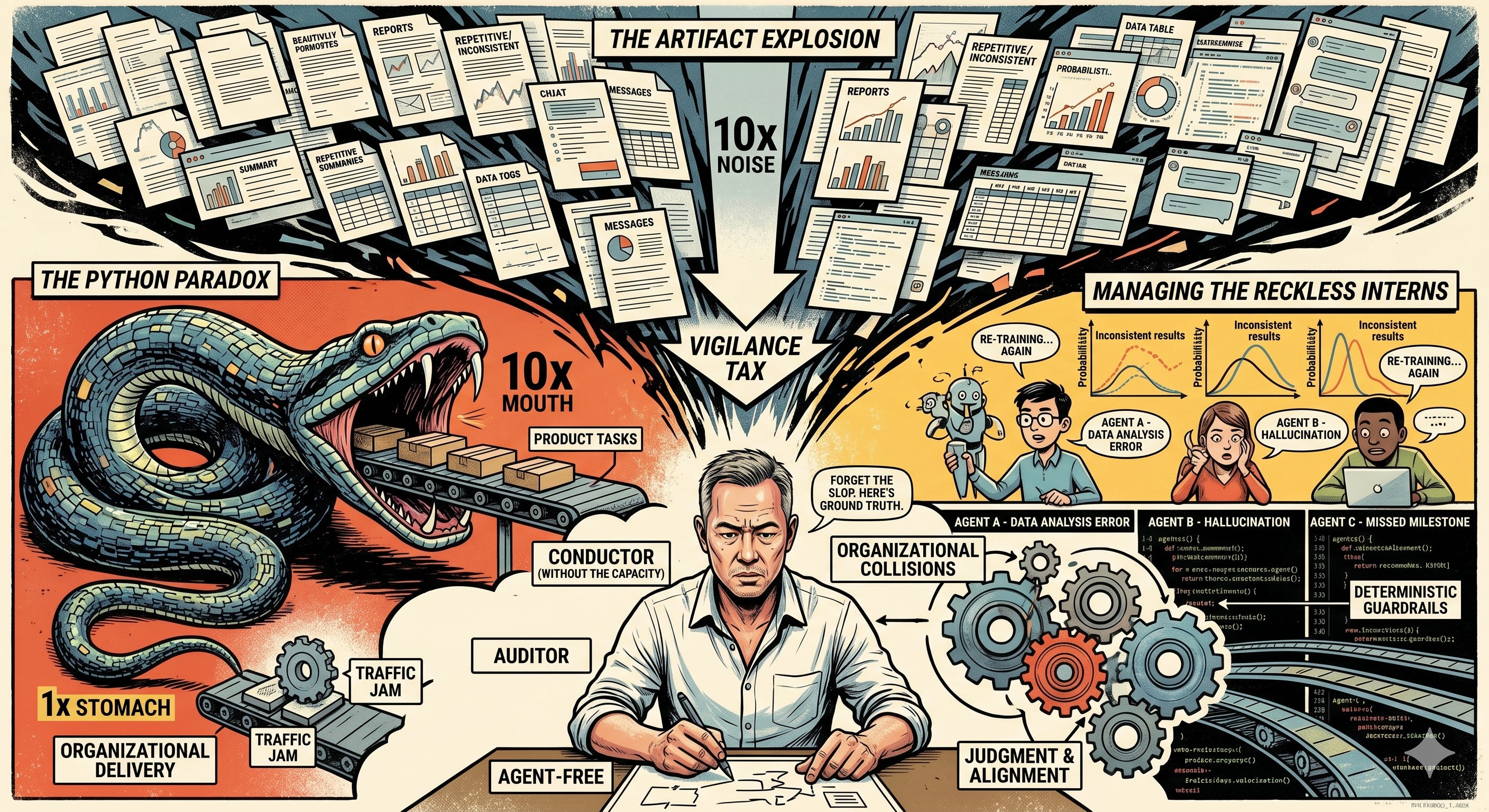
Today, that space has collapsed. We’ve replaced waiting with a 10x cycle of “continuous prompting.” But as the speed has increased, so has the cognitive tax. We aren’t just working faster; we are working under a higher Vigilance Tax.
1. The Vigilance Tax: Auditing the “Artifact Explosion”
The pain of the agent era isn’t just about managing your own outputs. It’s that everyone now has a 10x mouth. Your colleagues, your stakeholders, and your own agents are producing an unprecedented volume of artifacts.
The problem? Their physical form, the beautiful formatting and authoritative tone, belies a total lack of depth. We are being buried in “noisy artifacts” that came from a one-sentence prompt. Because the agents are so fast, you are forced into a state of permanent, high-intensity audit.
I’ve lived this recently. I’ll ask an agent for a summary of weekly wins, and it misses the most critical milestone while hallucinating a minor detail into a “top priority.” Or I’ll ask it to scan my communications, and it gives me a list of 50 reminders. It can count, but it can’t read the room. It doesn’t know that of those 50 things, one specific issue requires me to get in front of leadership immediately.
If you spend all your energy correcting the machine’s homework, you lose the capacity to see the one signal that actually matters.
2. The Python Paradox: A 10x Mouth with a 1x Stomach
Imagine a python that suddenly grew a mouth ten times its original size. It can swallow everything in sight, but its digestive system, the actual organizational ability to ship, the sales team’s ability to pitch, the customer’s ability to learn new UI, remains exactly the same.
This is the “Product Development Traffic Jam.” We are generating tasks at light speed, but they are colliding and getting stuck in the “digestive tract” of the company. As a PM, your value has shifted from “feeding the snake” to preventing it from choking. You are the buffer between the high-speed agent output and the slower-moving human parts of the company.
3. The “Yosemite Test”: Conviction vs. Knowledge
This shift is changing how we evaluate talent. When I interview candidates now, I’m looking for the Yosemite Test.
Anyone can prompt an agent to write a market analysis. It will look professional, but it will feel like someone describing Yosemite after a quick Google search. They can tell you the height of El Capitan, but they can’t tell you how the mist hits your face on the Mist Trail, or how your legs burn as people crowd past you on the narrow stone steps.
In a world of “AI-co-authored” work, the “Human Sniff Test” is everything. You’ve reached a state of Iterative Slop when a document is internally inconsistent or absent of compelling, lived-experience details. When you hit that “blob,” stop. Grab the pen. Ten minutes of journaling your own high-conviction point of view is worth more than three hours of poking the AI blob with a stick.
4. Deterministic Guardrails in a Probabilistic World
The biggest issue with agents is that they are probabilistic; they are brilliant but reckless grad school interns. They do a task perfectly on Monday, then “forget” the nuance on Wednesday.
To survive, you have to turn your repeatable “hundreds of little rules” into deterministic skills.
I’ve had to do this with my own “second brain.” You can’t just tell an agent, “Go check my chats.” You have to build a specific skill with hard rules: Which spaces are high-priority? Who are the stakeholders I must always check? What keywords signal an FYI versus an immediate action? Ironically, these skills get so complicated that they eventually slow the agent down. We are all currently building our own bespoke “trust layers” because we aren’t ready to take off-the-shelf logic for our most sensitive organizational relationships.
5. The Existential Shift: Leader or Auditor?
This leads to a hard question for PM leaders: Does this change who we are?
We used to define our roles through strategy, talent development, and organizational leadership. But look at your calendar. Do you spend your time developing people, or are you spending it as a High-Speed Auditor of noisy artifacts?
We are ending each day more “brain fried” than ever before. We are putting out significantly more work, but the jury is still out on whether we are having more long-term impact. If we spend all our energy correcting agent output, we aren’t leading the future; we’re just proofreading it.
Fireside Chat:
I’m curious to hear from you.
Do you feel like you’re still doing “strategy,” or have you become a full-time auditor?
What is your version of the “Yosemite Test” when you’re looking at work from your team?
Drop a comment or hit reply and I’ll respond. Let’s figure out how to save the python from choking.